Leadership Due Diligence – Leadership Competence, Risks & Potential

Leadership Due Diligence provides you with reliable, valid, and comprehensive insights into leadership candidates—serving as a solid foundation for making decisions regarding key positions and critical roles. It is a structured, multidimensional assessment and evaluation process that goes beyond traditional interviews. We combine scientifically grounded diagnostics, behavioral observation, and reference analyses to comprehensively assess potential, risks, and fit.

Employees usually don’t leave their company—they leave their boss. Our Leadership Due Diligence assesses the state of the leadership culture and leadership quality within the organization or relevant units. It is an ILD evaluation process through which we show you where your company stands in terms of leadership culture. We advise and support you in establishing a constructive culture of conflict resolution, feedback, and development, and in revitalizing the leadership culture.


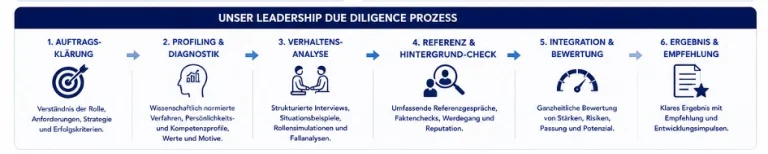
Leadership Due Diligence Process – Brief Description of the Process Steps (Example)

1) Scope Clarification & Goal Definition
  • Defining the objectives, the evaluation framework, and the relevant leadership requirements in the context of strategy, culture, and transformation.
  • Information Gathering & Document Analysis
  • Analysis of existing documents such as organizational charts, performance data, employee feedback, CVs, or corporate strategy.
2) Profiling & Diagnostics
  • Interviews & Stakeholder Discussions
  • Structured discussions with executives, employees, and relevant stakeholders to assess leadership competencies, impact, and collaboration.
  • Profiling & Competency Assessment
  • Competency analysis: Assessment of leadership attitudes and behaviors, including communication skills, conflict management skills, change management skills, tolerance for ambiguity, entrepreneurial potential, empowerment skills, cultural fit, and potential based on defined criteria and, where appropriate, psychometric methods.
3) Risk and Potential Analysis
  • Identification of leadership risks, areas for development, succession issues, as well as the strengths and future potential of the leadership team.
4) Report & Recommendations for Action
  • Summary of the findings, including specific recommendations regarding development, staffing, governance, or transformation.
  • Follow-up & Development Measures

5) Support for Implementation, e.g., through development centers, coaching, team development, talent reviews (including succession planning), or monitoring of defined measures.


Audit objective and procedure (example)

Our ILD Leadership Culture Audit is a structured process designed to assess the quality and effectiveness of leadership in an organisation. Selection of our steps, which are adapted and carried out according to need and situation:

  1. Audit objective: to identify the strengths and weaknesses of the leadership culture, examine specific leadership qualities or identify specific areas for improvement ?
  2. Audit planning: target-related definition of the scope of the audit, the areas to be audited and the methods to be used
  3. Analysis of the degree of implementation and quality of HR policy instruments and processes such as talent management systems, leadership development programmes, semi-structured interviews with managers and employees
  4. Implementation in accordance with the audit plan: conducting interviews, development centres, analysing survey data and documents, reviewing policies and procedures and observing leadership behaviour
  5. Data collection and analysis: collecting and analysing all relevant data, identifying trends, patterns of action and improvements (e.g. effectiveness of communication, handling of conflicts, empowerment of employees)
  6. Evaluation of surveys, 360-degree feedback, development centre results, talent review results, analysis of personnel-related documents and observations
  7. Stakeholder-related presentation of the audit results with recommendations for action to improve the leadership culture and leadership quality, proposals for measures to monitor effectiveness and presentation of the overall result achieved
  8. Option: Regular review of the effectiveness of the implemented measures

A leadership culture audit can help to raise awareness of the importance of positive and effective leadership and support the organisation in developing a culture that promotes employee engagement, productivity and well-being in equal measure.

Audit categories

  1. Future leadership culture – Audited
  2. Effective leadership culture – Evaluated
  3. Excellent leadership culture – Awarded
  4. Dynamic leadership culture – Special awarded for dynamic transformation

Leadership Due Diligence Prozess – Kurzbeschreibung der Prozessstufen (Beispiel)

1) Auftragsklärung & Zieldefinition
  • Festlegung der Zielsetzung, des Bewertungsrahmens und der relevanten Führungsanforderungen im Kontext von Strategie, Kultur und Transformation.
  • Informationssammlung & Dokumentenanalyse
  • Analyse vorhandener Unterlagen wie Organigramme, Performance-Daten, Mitarbeiterfeedback, CVs oder Unternehmensstrategie.
2) Profiling & Diagnostics
  • Interviews & Stakeholder-Gespräche
  • Strukturierte Gespräche mit Führungskräften, Mitarbeitenden und relevanten Stakeholdern zur Einschätzung von Leadership-Kompetenzen, Wirkung und Zusammenarbeit.
  • Profilings & Kompetenzbewertung
  • Kompetenzanalyse: Bewertung von Führungshaltungen und -verhalten mit u.a. Kommunikationskompetenzen, Konfliktkompetenzen, Veränderungskompetenzen, Ambiguitätstoleranz, Unternehmerpotenzial, Befähigungskompetenzen, kultureller Passung sowie Potenzial anhand definierter Kriterien und ggf. psychometrischer Verfahren.
3) Risiko- und Potenzialanalyse
  • Identifikation von Führungsrisiken, Entwicklungsfeldern, Nachfolgefragen sowie Stärken und Zukunftspotenzialen des Leadership-Teams.
4) Bericht & Handlungsempfehlungen
  • Zusammenfassung der Ergebnisse inklusive konkreter Empfehlungen zu Entwicklung, Besetzung, Governance oder Transformation.
  • Follow-up & Entwicklungsmaßnahmen

5) Begleitung der Umsetzung, z. B. durch Development Centern, Coaching, Team-Entwicklung, Talent Reviews inkl. Nachfolgeplanung oder Monitoring definierter Maßnahmen.

Leadership Due Diligence

Leadership Due Diligence is a structured analysis of leadership profiles before or during:
  • Investments (VC, PE, M&A)
  • Restructurings
  • Scaling phases
  • Successions
  • Transformations
  • Board decisions

For founders, the focus is often on the scalability of leadership, the ability to professionalize, handling pressure and uncertainty, building a team and culture, the ability to learn and adapt, and governance maturity.

Benefits of Leadership Due Diligence

For the company’s public image
  • Greater credibility with investors and banks
  • Increased trust among customers, partners, and stakeholders
  • A more professional corporate image
  • A signal of good governance and sustainable leadership
  • Greater appeal to top talent and executives
  • Greater security for investors during periods of growth or crisis
  • Positive impact on company valuation and financing opportunities
  • Strengthened reputation during transformations or restructurings
  • Perception as an organization capable of learning and developing
  • Improved communication capabilities externally and toward the market
For Company Leadership
  • Faster and more informed leadership decisions
  • Early identification of leadership and scaling risks
  • Higher probability of success in growth or restructuring
  • Clarity regarding roles, responsibilities, and succession
  • Improved team and management performance
  • Objective basis for investor, board, and personnel decisions
  • Targeted development of founders and executives
  • Reduction of conflicts, bottlenecks, and miscasts
  • Stronger governance and a more professional organization
  • Greater trust among investors, banks, and stakeholders
For Investors
  • Early identification of leadership risks
  • Greater forecasting accuracy
  • Fewer mis-hires
  • Better post-merger/post-investment integration
For Boards / Supervisory Boards
  • Objective basis for decision-making
  • Clarity on areas for development
  • Succession and role planning

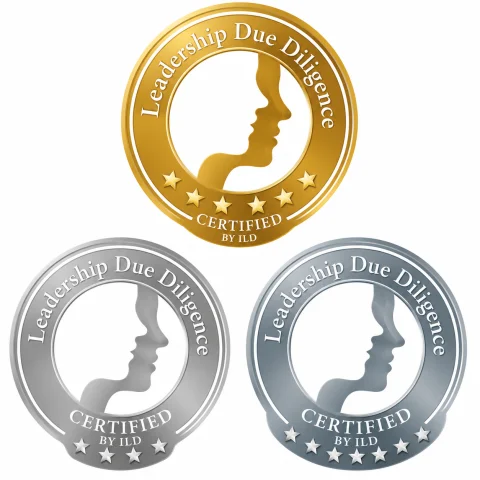
Examples of Certification Levels

  1. Bronze ***: Solid foundation in place
  2. Silver ****: Professional leadership maturity
  3. Gold ****: High scalability and governance maturity
  4. Platinum ******: Best-in-class leadership and transformation excellence

Leadership today is different.

Decision-makers sometimes lack self-reflection, authenticity, and effective relationship management based on mutual respect.
Since a company’s competitiveness is increasingly determined by the cultural quality of collaboration and leadership, trust-based, cooperative, coaching-oriented, and situational leadership has become a key success factor. Leadership Due Diligence with ILD shows you what you need to do to positively influence the contribution of all stakeholders to the company’s development.

Culture as a Game-Changer.

An adaptive and dynamic leadership culture—one that includes constructive conflict resolution, feedback, and development—is central to a company’s success. By investing in strong cross-functional collaboration and effective leadership, you can achieve an unbeatable return on investment. Our integrative approach focuses on diagnosing and aligning attitudes, managing emotions, and developing the 4Cs key competencies. With ILD, you’ll learn how to make transformation processes more effective, efficient and sustainable.


  • “My board colleague Daniel Mohaupt and I have once again worked with the professionals from ILD on their professional selection process for filling 2 important key leadership positions. 5 candidates learned a lot about themselves in an assessment centre and showed us a lot about themselves. They felt very comfortable in the process. We ourselves, were very convinced by the methods and profiling of ILD EvaluationHours. We were also able to get a very good picture of each individual applicant, both internal and external, and make a good decision. Thanks to ILD (Frank Strathus, Arndt Kempen, Kirsten Strathus), we can only recommend both your methods for personnel selection and the profilings!”

    Grit Westermann | Chairwoman of the Board, PSD Bank

  • “The most impressive thing about the 4Cs method is the justified conflict focus and the combination of scientific standardization with high practical relevance, which enables a fast and effective behavioral change. ILD has been highly professional in guiding us in this. Thank you.”

    Walter Schaff | Director HR Europe, Daimler Financial Services

  • “As part of our global ‘Conflict Resolution and Mediation Conference’, Frank and Stefan held a very well received best practice session. Due to the close cooperation we could state: a really good investment in our knowledge. ILD is on the cutting edge as a leading Leadership Institute.”

    Kelly Kirschner | Vice President and Dean of Executive and Continuing Education at Eckerd College, Florida/USA

  • „At first I was skeptical and attended the first appointment more out of curiosity. But views that I was actually comfortable with began to waver, while on other issues I was encouraged to continue on the path I had chosen. There are statements from my coach that I won’t soon forget and that I continue to use as a guide today.”

    Dr. Bärbel Wernicke | DIN Head of LUW (Leben und Umwelt/Living and Environment)


Curi­ous now?

If you would like to learn more about our offer or have a spe­cif­ic in­quiry, please send us a mes­sage.

Your direct contact:

Arndt Kempen, Frank Strathus